Max Laubstein
Research Talks Things
Blue Canyon

Research

STJA

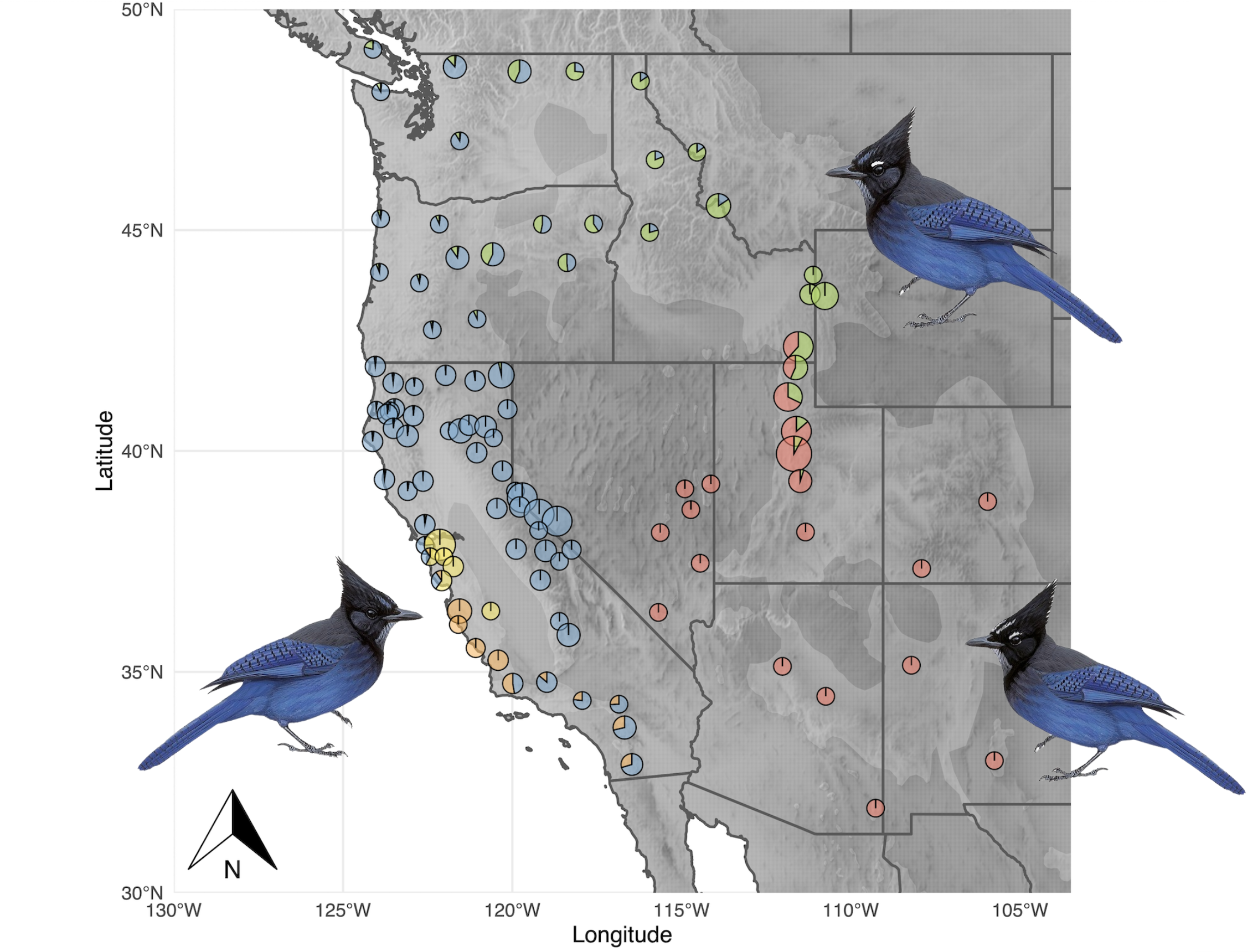
Rangewide Genomics of Steller's Jays

For much of my undergraduate experience, I worked on the analysis of a whole genome resequencing dataset of 310 Steller's Jays (Cyanocitta stelleri). 150 of these genomes were generated as part of the California Conservation Genomics Project, and I prepared the remaining 160 libraries over the summer of 2023, in the Evolutionary Genetics Lab of UC Berkeley's Museum of Vertebrate Zoology. Prior work (Cicero et al., 2023) identified remarkably deep genetic divergence between two major clades that come into contact in the Interior Western United States, suggesting Steller's Jay may consist of more than one species. I utilized this large whole genome resequencing dataset to assess rangewide population structure, species limits, demography, and the genetic underpinnings of trait variation.
Paleobiogeography of Plethopsis

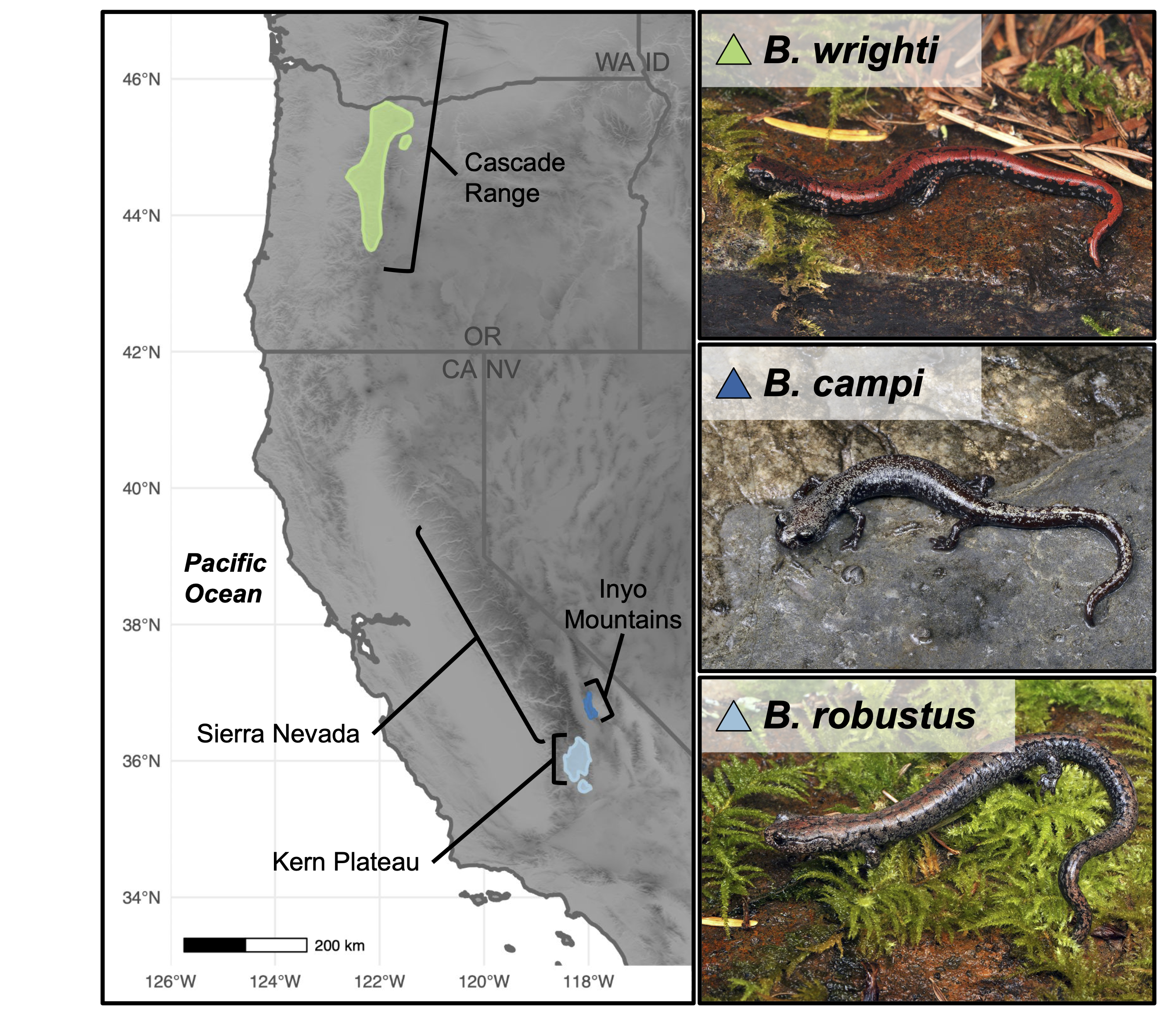
Starting in my first year at UCSB, I used phylogenetics to understand the paleobiogeography of an anomalous group of salamanders: the slender salamander (Batrachoseps) subgenus Plethopsis. This subgenus consists of 3 species: Batrachoseps wrighti (Oregon Slender Salamander), B. campi (Inyo Mtns. Salamander), and B. robustus (Kern Plateau Salamander). These species are found in mind-blowing habitats for salamanders: B. campi, for example, is found only in a select few riparian springs in the desert Inyo Mountains (not too far from Death Valley, for reference). Despite the 800+ kilometers that separate B. wrighti from B. campi, prior phylogenetic work (Jockusch et al., 2015) suggests these 2 species are recently-diverged sister species, with the Kern Plateau's B. robustus as an outgroup. From integrating phylogenetic divergence time estimation with geological sources, I've worked to reconstruct the speciation history of Plethopsis, to inform fieldwork in search of potential undiscovered relict species. (Plethopsis photos courtesy of Robert Hansen).
plethopsismap